
Patio Base Installation Guide: Dense-Grade vs. Open-Grade
- Home
- >>
- Patio Base Installation Guide: Dense-Grade vs. Open-Grade
Table of contents
Understanding Dense-Grade Base Systems
How Dense-Grade Base Is Installed?
Advantages of Dense-Grade Base:
Understanding Open-Grade Base Systems
How Open-Grade Base Is Installed?
Advantages of Open-Grade Base
Which Base System Is Best?
The Importance of Proper Installation
At M&G Landscaping, we focus on layers for durability, drainage, and how a structure performs over time. Two methods used in a majority of industry hardscape installation are dense-grade base and open-grade base systems. Each possess advantages and are best used in specified site conditions.
Understanding Dense-Grade Base Systems
A dense-grade base (also called “traditional base”) uses crushed aggregate with a mix of particle sizes—from fine stone dust up to larger crushed stone. Because the smaller particles fill the gaps between larger stones, the material compacts tightly into a firm, stable layer.
This base has been used in hardscape construction for a long time and is still the go-to choice for patios, walkways, and driveways.
How Dense-Grade Base Is Installed?
- Excavation:
The first step is excavating the patio area to the proper depth. For most patios, this means removing soil to allow room for 6–8 inches of base material plus bedding sand and the pavers themselves. Excavation also establishes the correct slope so water drains away from structures. - Subgrade Preparation:
The ground needs to be compacted using a plate compactor as a rigid subgrade needs to be created. Soil that is on the softer, weaker side, or cannot hold weight needs stabilization in order to be compacted. - Geotextile Fabric Installation:
Geotextile fabric is used over the subgrade to prevent the soil mixing with the base material. - Doing The Dense-Grade Aggregate:
Processed gravel or road base is put in lifts of 2-3 inches. Each lift of Gravel aggregate needs to be compacted completely before the next lift is placed. This is an imperative step to create a strong base. - Final Grading and Bedding Layer:
When the base reaches the desired depth and slope, a 1 inch layer of concrete sand is placed on the top of the base to create a smooth bedding surface for pavers. - Paver Installation:
The pavers are placed, and compacted with the joint sand placed to lock everything in.
Advantages of Dense-Grade Base:
- Proven, traditional installation method
- Very strong when properly compacted
- Works well in many typical patio environments
- Generally lower material cost
However, dense-grade bases rely heavily on surface drainage, because the compacted fines reduce water permeability. If water becomes trapped beneath the patio-particularly in clay soils-it can lead to frost heaving in colder climates.
Understanding Open-Grade Base Systems
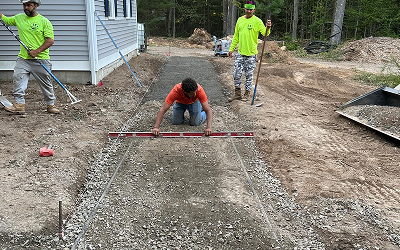
An open-grade base uses larger, uniformly sized crushed stone with little to no fine particles. Because the stones do not compact into a solid mass, the base remains highly permeable, allowing water to move through the system instead of sitting beneath the patio.
This system is commonly used in permeable paver installations, but it is increasingly used for standard patios because of its superior drainage performance.
How Open-Grade Base Is Installed?
- Excavation:
Similar to dense-grade installations, the patio area is excavated to allow for base depth. Open-grade systems often require 8–12 inches of base material, depending on the application. - Geotextile Fabric Installation:
A geotextile fabric is often installed over the soil subgrade. This fabric prevents soil from migrating into the stone base while still allowing water to pass through. - Drainage System:
In some open grade base installations drainage pipes can be installed on top of the fabric to carry water captured in the base layer and bring it to daylight away from the patio area. - Installing the Open-Grade Stone Base:
The base typically consists of angular crushed stone such as 11/4” crushed stone or ¾” trap rock. Because the stones are uniform in size, they create void spaces that allow water to drain freely. - Compaction:
Unlike dense-grade bases, open-grade bases do not compact into a solid mass. Instead, the stone is lightly compacted or vibrated to settle the stones into place without crushing the void structure. - Bedding Layer:
Instead of sand, a small clean stone such as ⅜” gravel stone or ¼” chip stone is used as the bedding layer for the pavers. - Paver Installation:
Pavers are installed and compacted, and joint material (often polymeric sand) is added to secure the surface.
Advantages of Open-Grade Base:
- Excellent drainage performance
- Reduces water buildup beneath the patio
- Helps minimize frost heaving in colder climates
- Often required for permeable paver systems
- Can support larger installations without increasing runoff
Because water infiltrates the base instead of running off the surface, municipalities are often more flexible with larger permeable patio or driveway installations since they do not contribute additional stormwater runoff.
Check out one of our open grade base system installations in the video below:
Which Base System Is Best?
The correct base system depends on the soil conditions and drainage requirements. It pertains to specific uses. Correct installation is paramount:
- Dense-Grade Base Works Best For:
- Standard residential patios and walkways.
- Areas with well-draining soils.
- Projects where cost is paramount.
- Areas with surface drainage away from structures
- Open-Grade Base Works Best For:
- Areas deficient in clay or soil with poor drainage.
- Patios with drainable pavements or paver patios and driveways.
- Large areas with drainage issues.
- Areas with a high propensity for freeze-thaw cycles.
- Areas of poor drainage and focus on stormwater issues.
The Importance of Proper Installation:
Regardless of the base system chosen, the most important factors in patio longevity are excavation and the planning of drainage. Most patio failures are not due to the pavers, but rather a base system installed incorrectly, or the system lacking appropriate depth.
We have the expertise to evaluate each specific project to determine the best base system for M&G Landscaping LLC. We evaluate the soil, drainage, and intended use to ensure every patio we build serves our clients for many years.
Thinking about installing a patio?
We are here to help. Contact our M&G Landscaping team to design and build an outdoor space that looks incredible while it is engineered to last!